
Monday AI & Growth Brief:The Customer Journey Is Starting to Leave the Website
28 September 2026 · covering 21–28 September
For twenty years, digital marketing has quietly assumed that the website is where the important part of the customer journey happens. We built most of our tools around that assumption.
SEO gets people there.
Ads get people there.
Analytics watches them arrive.
CRO watches what they do next.
AI is starting to dismantle that neat sequence. Discovery can happen inside ChatGPT. Comparison can happen inside Gemini. Visual search can begin with a camera. Product selection can happen inside an agent. And now, increasingly, the purchase itself can happen without the customer visiting the website at all.
I don’t think the website is disappearing, despite what some of my colleagues keep saying. I could be wrong, but I don’t see it yet. But I do think its monopoly on the measurable customer journey is disappearing, whih creates a much more interesting question than whether AI is going to “replace websites”:
If fewer parts of the customer’s decision happen on properties we control, what exactly should marketers optimise and measure?
Ok now, on with the update:
1. Google Search Console can now tell you when someone searched with an image
On 24 September, Google Search Central added a new multimodal search filter to Search Console.
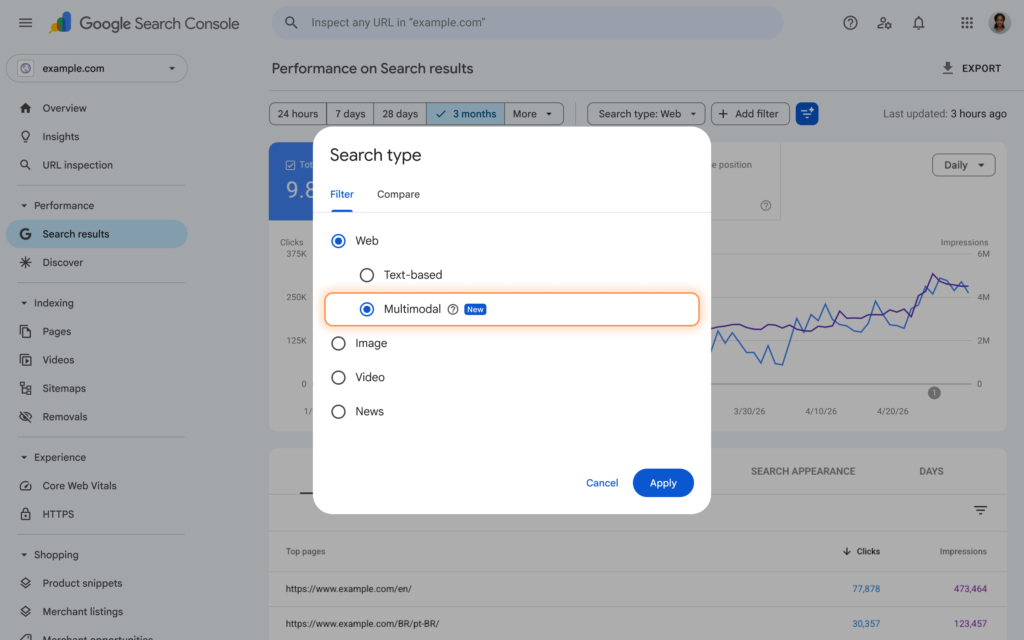
It covers searches originating from:
- Google Lens
- Circle to Search on Android
- images uploaded into Google Search
- Chrome’s “Search this image” function.
Importantly, Google has added the data both to the normal Search performance report and to its Generative AI reporting. The rollout is global.
This is easy to dismiss as another Search Console filter, but I think it is more interesting than that. SEO reporting has traditionally assumed the unit of demand is something roughly equivalent to “person types words and search engine returns a list of pages”. For a while now, we have been introduced to a new way to searching, we can now point their phone at a dress, hotel, plant, product or object and effectively ask Google: “What is this?” or “Find me something like this.” without articulating the need in keywords at all.
Keyword research cannot capture demand that never began as words.
For ecommerce, travel, fashion, local businesses and visually distinctive products, we should start thinking about establishing a multimodal Search baseline now.
Don’t optimize around it yet. First understand:
Which pages surface?
Which devices dominate?
Which countries?
Does visual discovery lead to commercially useful traffic?
I will most likey add a Multimodal Discoverability as a small diagnostic inside future SEO/AEO audits, to include text discovery + AI discovery + visual discovery.
2. Google Ads is beginning to expose the journey its AI created
On 23 September, Google expanded AI Brief into Portuguese, Spanish, French, German, Italian, Dutch and Japanese.
AI Brief allows advertisers to describe their business, audience and important messaging in natural language so AI Max has additional context when optimizing Search campaigns.
More interestingly, Google announced a forthcoming AI Max reporting interface that connects search term, creative shown and landing page selected into one view (my CRO personality is having a part to celebrate this). Google says further availability details will arrive later this year.
AI Max creates an observability problem. If Google increasingly decides:
- which searches you’re eligible for
- which message to show
- which asset to use
- where on the website to send someone,
then the traditional unit of PPC analysis becomes slippery. You are no longer just analyzing the flow from keyword to ad and landing page. You are analyzing a system making several decisions between those things.
Google adding this report is tacit recognition that advertisers need to inspect those decisions.
When this becomes available, I will consider making it part of routine Google Ads/CRO analysis.
For every significant AI Max path:
- Was the query commercially relevant?
- Did the generated message match that intent?
- Did Google choose the landing page I would have chosen?
And then:
- Did that combination convert?
There’s a potentially strong crossover service here: AI Media Journey Audit, which is something I have been wanting to offer for a very long time.
Rather than separating SEO/AEO/GEO, PPC and CRO: query intent → machine targeting decision → machine-generated message → machine-selected landing page → user behavior → conversion.
3. Google is also quietly giving advertisers better ways to audit the machine
On 23 September, Google Ads API v25.2 introduced several useful additions, including competitive percentile benchmarks and additional Performance Max controls/reporting fields.
On its own, I wouldn’t put an API release in this brief, but combined with the AI Max reporting announcement, it reveals a useful pattern: automation is increasing, but Google is simultaneously having to build observability back into the system.
That principle extends well beyond advertising.
As AI makes more decisions, marketers need better audit trails, not fewer reports. I’d carry that principle directly into my own AI workflow architecture: If a machine makes a decision that affects money, customers or analysis, can I reconstruct why?
4. Checkout is starting to leave the website
This is probably the week’s biggest CRO development.
Eligible U.S. Shopify merchants are now being rolled into direct checkout inside Google AI Mode and Gemini.
Customers can discover a product and complete a Shopify-powered checkout without leaving the AI conversation.
Even more consequentially, direct checkout is enabled by default for eligible stores, although merchants can disable it. It currently applies to qualifying U.S.-based stores selling to U.S. customers.
During the same week, Shopify also announced an integration allowing Meta’s new Muse AI agent to complete purchases using Shop Pay.
Two different AI ecosystems moving toward embedded commerce in the same week is much more interesting than either announcement alone.
We’ve spent years optimizing: ad/search → landing page → PDP → cart → checkout.
Agentic commerce can compress that into: conversation → product → checkout.
Some of the experience we obsess over just disappears. I don’t think that means CRO disappears, but it’s going to change. It means the optimization surface moves.
Product information, structured data, pricing, availability, trust, reviews and machine-readable attributes increasingly influence whether the product enters the consideration set before the website gets a chance to persuade anyone.
Am I going to change my offers?
For example, for ecommerce clients, should I separate Website CRO from Agentic Commerce Readiness?
The second asks:
- Can machines accurately understand the catalogue?
- Is product information sufficiently rich?
- Are prices and availability reliable?
- Can the system distinguish products properly?
- What happens to upsells, bundles and loyalty?
- What customer data survives an external checkout?
- How are these orders measured?
And crucially: Should this merchant actually enable native checkout?
Reducing friction may increase conversion while simultaneously reducing opportunities for merchandising, upselling or first-party behavioral measurement.
That’s an experiment, not an article of faith.
5. This creates a nasty little analytics problem
Google’s native Shopify checkout is also a useful preview of where measurement is heading.
If the transaction occurs inside an external AI interface, a conventional website session is no longer a prerequisite for revenue.
The sale still exists.
The website journey might not.
That makes our familiar funnel an incomplete representation of the business. This matters beyond Shopify. As agentic commerce expands, I’d increasingly design ecommerce reporting around: discovery source → commerce environment → order → customer rather than assuming every order should map neatly to a website session.
That’s a substantial analytics architecture change hiding inside what looks like a checkout feature.
6. GA4 gave us a small but genuinely useful data-integrity feature
On 21 September, GA4 added Include hostname filters.
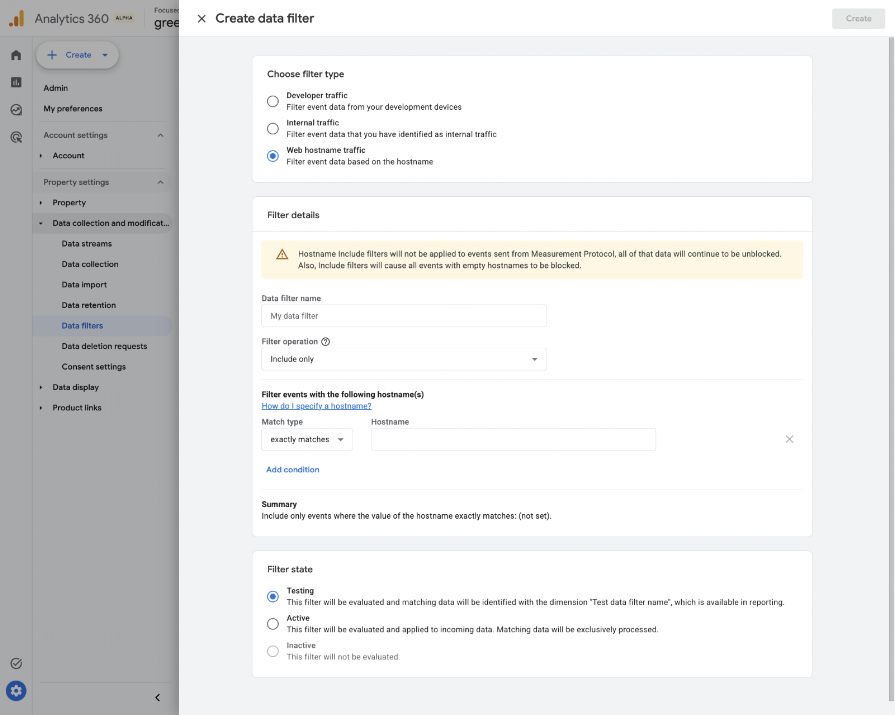
Previously, hostname filtering relied primarily on exclusions. You can now explicitly define the domains permitted to send browser event data into a property.
For example:
Accept example.com
Accept checkout.example.com
Reject everything else.
This is not glamorous, but it sure is useful.
Analytics properties can accumulate spam, rogue implementations, staging traffic or tags accidentally deployed on domains they shouldn’t be.
One caveat: Google says these filters do not apply to Measurement Protocol events, so server-side/event-import architectures still need separate validation. Google Help
I’d add hostname validation to your analytics QA checklist. For properties that should only receive browser data from a known handful of domains, an Include filter can reduce future contamination.
But test it before activation. A forgotten payment domain, booking engine or subdomain could otherwise disappear from reporting rather spectacularly. 🫠
7. AI workflow systems are getting persistent, and now cost governance is becoming part of the architecture
On 25 September, Microsoft announced a substantially redesigned Copilot with Home, Code and Autopilot.
Autopilot is particularly relevant: it is a persistent agent designed to continue working when the user isn’t present.
Microsoft is pairing these longer-running agents with usage-based billing and new controls for:
- spending policies
- model availability
- credit approval
- agent cost monitoring
- task-level outcome analysis.
Does this mean that I now need to add Cost to my workflow architecture? Because persistent agents introduce a new failure mode where we go beyond whether or not the agent did the right thing, we are going to have to ask if it spent €43 doing something worth €3.
That’s going to matter a lot once agents routinely research, browse, call APIs and invoke other models without someone watching every step. I get nervous just thinking about it.
So, for my own workflows, I’ll start measuring:
- Task
- model/tool usage
- Cost
- output quality
- time saved.
That creates something most AI automation projects currently lack, unit economics.
Eventually that could become part of an AI Workflow Audit:
- Where should AI reason?
- Where should deterministic automation run?
- Where should a cheaper decision model handle the task?
- Where is human judgment cheaper or safer?
Jev from last week’s brief fits beautifully into that model.
8. Agentic commerce is already raising trust questions, not just conversion questions
A Reuters report on 22 September found major banks including NatWest, Bank of America, ING and Capital One raising concerns about AI shopping agents around fraud, payment security, data handling and consumer recourse.
This is an important counterweight to the frictionless-checkout narrative we keep hearing. From a behavioral perspective, removing friction is not universally good.
Some friction provides:
confirmation
control
error prevention
trust
reflection.
We’ve known this in CRO for years. A confirmation screen that prevents a €2,000 mistake isn’t “conversion friction.” It’s useful friction.
As AI agents begin making purchases, CRO may need to distinguish much more carefully between friction that obstructs intent and friction that protects agency.
I suspect that’s going to become a surprisingly important design principle.
What I would actually do this week
1. Add multimodal Search to your SEO/AEO measurement framework. Check whether relevant clients already have enough Search Console data to establish a baseline. Don’t optimize yet. Measure first.
2. Add GA4 hostname validation to analytics QA. Especially for mature properties with multiple domains, subdomains or old implementations.
3. For ecommerce work, create an “Agentic Commerce Readiness” diagnostic. Product-data quality, machine accessibility, checkout ownership, attribution, upsells, customer data and measurement belong together now.
4. Update my AI workflow framework to include cost. For every automated workflow you’re considering, capture not only whether it works but what each successful output costs.
