
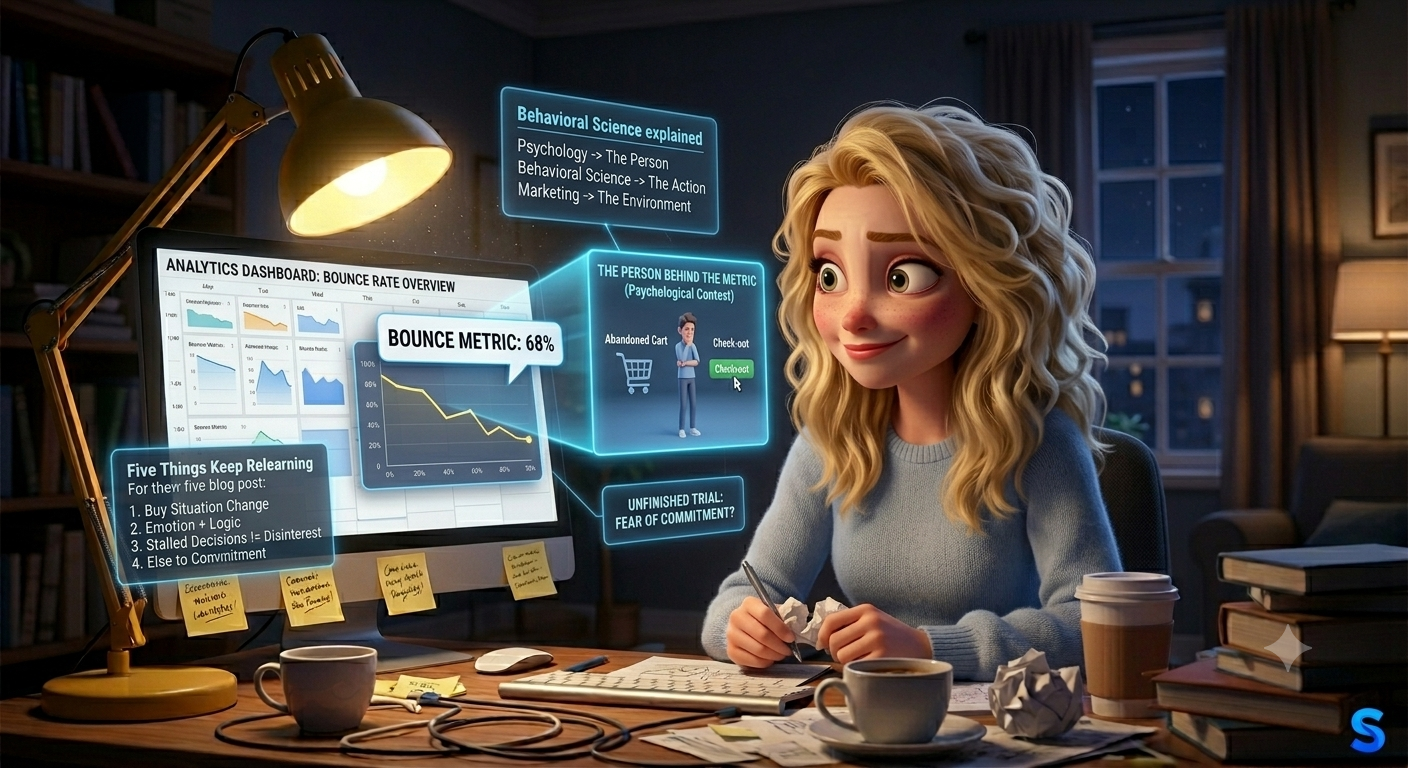
The Behaviour Behind the Metric: Why Marketing Must Begin With Psychology
Behavioral science in marketing means using research into how people actually decide (under uncertainty, limited attention, and competing priorities) to explain patterns like bounces, cart abandonment, or a stalled trial sign-up, and to design marketing around that reality instead of around persuasion tactics. It sits between psychology, which explains the person, and marketing, which shapes the environment they’re deciding in.
Every Number on Your Dashboard Is Also a Person
Open any analytics dashboard and you’ll find a story told entirely in outcomes. A bounce rate. An abandoned cart. A form started and never finished. A trial that quietly expired.
It’s tempting to read these as verdicts, the offer wasn’t strong enough, the copy didn’t land, the CTA needs to be bolder. Sometimes that’s true. But every one of those numbers is also a person, at a specific moment, trying to make a decision with the time, attention, and certainty they had available to them right then.
That’s the territory I am moving into with this article. Not another list of cognitive biases to deploy, but a more honest question:
How do we understand the person behind the conversion, given that marketers are not outside consumer behaviour? We are consumers too.
The metric records what happened. Psychology helps us understand what the person may have experienced. Behavioral science helps us form and test explanations for it. Marketing and product design decide what happens next. Those are four different jobs, and most marketing content collapses them into one.
What Behavioral Science Actually Means in Marketing
Behavioral science is the study of how people actually behave, as distinct from how they say they’ll behave, or how a spreadsheet assumes they will. In marketing, it’s the discipline that sits between two other fields people often use interchangeably with it:
Psychology explains the person, their motivations, emotions, memory, and mental models.
Behavioral science explains the action, the testable, observable patterns in how people behave in specific situations, under specific constraints.
Marketing (and product design) shapes the environment, the page, the email, the pricing table, the checkout flow, where that behaviour actually plays out.
Applying behavioral science well means using it to explain and predict, not just to persuade. A checkout flow redesigned around genuine friction reduction is behavioral science. A countdown timer built on a fake deadline is not, it’s borrowing the language of behavioral science to dress up a trick.
Why the Internet Is Full of Bias Lists, and Why That’s Not Quite the Point for Me
Search this topic and you’ll mostly find the same six or seven principles recycled across agency blogs: loss aversion, social proof, anchoring, scarcity, the endowment effect. They’re not wrong. They’re documented, replicated, genuinely useful patterns.
But treating them as a toolkit “pick a bias, bolt it onto a landing page” skips the harder and more useful question: “what is this specific person, in this specific moment, actually uncertain about?” and a bias list gives you a lever. It doesn’t tell you which lever this person needs, or whether pulling it serves them or just serves the conversion rate.
That’s the gap I am hoping this series sits in.
Five Things I Keep Relearning About the People Behind the Metrics
These aren’t rules. They’re recurring patterns I keep coming back to when a number on a dashboard doesn’t match what I’d expect.
1. People don’t buy products. They buy a change in their situation. Nobody wakes up wanting a feature. They want something in their life to become easier, safer, or more certain than it currently is. A flexible cancellation policy isn’t a policy, it’s a reduction in the fear of commitment. [INTERNAL LINK: People Don’t Buy Products, They Buy a Change in Their Situation]
2. Emotion makes us move. Logic helps us feel safe about the decision. Not “people are irrational”, people need both desire and safety before they act. Emotion signals that something matters; reason checks whether acting on it is sensible and defensible. [INTERNAL LINK: Emotion Makes Us Move]
3. A stalled decision can look exactly like disinterest, and rarely is. Someone comparing six near-identical options, juggling three open tabs, isn’t uninterested: their attention has hit capacity. That’s a friction problem, not a persuasion problem. [INTERNAL LINK: Your Customer May Not Be Uninterested]
4. People aren’t lying to you. They often can’t fully explain their own behaviour. What someone tells you in an interview and what they do on your site aren’t contradictory, they’re two different, equally real signals, shaped by memory, language, and how we explain ourselves after the fact. [INTERNAL LINK: Customers Are Not Lying to You]
5. Helping someone decide and manipulating them can look identical on a wireframe. The difference isn’t whether influence exists. All design influences behaviour. It’s whose interests the intervention serves, and whether it would still hold up once the person understood exactly how it worked. [INTERNAL LINK: The Difference Between Helping Someone Decide and Manipulating Them]
Context (device, timing, financial pressure, what tab they had open five minutes ago) shifts all five of these more than most personas admit. That’s worth its own piece too, later in this series.
How I Use This In Practice
This isn’t a purely academic interest. When I look at a funnel that’s underperforming, the first question usually isn’t “how do we make this more persuasive.” It’s closer to: where, specifically, is the person getting stuck (motivation, understanding, risk, or friction) and is that a copy problem, a structural problem, or a trust problem wearing a copy problem’s clothes.
That diagnostic approach is the backbone of the audit work I do. If you’re looking at a funnel or a page that should be converting better than it is, that’s CRO Audit territory.
Frequently Asked Questions
What is behavioral science in marketing?
Behavioral science in marketing is the practice of using research into how people actually make decisions to explain patterns like bounces, abandoned carts, or delayed sign-ups, and to design marketing around that reality rather than around persuasion tactics alone.
How is behavioral science different from consumer psychology?
Consumer psychology looks at the person (their motivations, emotions, and mental models. Behavioral science looks at the action) testable patterns in how people behave in specific situations. Marketing uses both to shape the environment where that behaviour plays out.
Is behavioral science in marketing manipulative?
It can be, but it doesn’t have to be. The same principle ,reducing friction, clarifying a default, making a cost visible early, can help someone decide with confidence or push them toward a choice they’ll later regret. The difference is whose interests the design serves.
How do I start applying this to my own marketing?
Treat a stalled metric as a question rather than a verdict. Instead of asking why something didn’t convert, ask what the person on that specific screen might have felt uncertain about, short on time for, or unable to evaluate. That question usually points to a testable change.
The Story Behind the Story
A conversion rate is a summary. It tells you what happened, not why. Behind every one of those numbers is someone weighing a decision with the attention, certainty, and time they had in that moment, and that’s true whether they’re looking at your pricing page or you’re looking at theirs later that evening.
This is the first piece in a short series working through what that actually means for how we build pages, write copy, and run experiments. Next up: why people buy products or services in the first place, and it’s rarely the product or service itself.
