
AI Doesn’t Replace Judgment. It Rewards People Who Know Where the Drag Is
A developer once told me something that stayed with me.
He worked full-time as an engineer for a tech company in the UK. He was smart, creative, and exactly the kind of person you would expect to adapt well to AI. He had side projects, built things for fun but when we talked about AI, his view was dark.
“I’m just waiting for the day they fire me because AI has made me redundant.”
What struck me wasn’t just the sentence. It was the resignation behind it. He was already using AI. He was already seeing the productivity gains and creative applications. But instead of feeling more powerful, he seemed to be preparing himself for impact.
That conversation stayed in the back of my mind, because I’ve heard versions of it before.
For years, developers were treated like the golden boys of the workforce. Meanwhile, as a marketer, I know what it feels like to be the first budget questioned and the first function cut when things get uncomfortable.
So part of me understood the fear, but another part of me wasn’t convinced the story was that simple because this week, I heard the opposite version twice.
AI Feels Different in the Hands of Someone Who Already Knows How to Build
I was having dinner with a friend who is COO at a tech company. She works with a SaaS product for marketing teams, so AI is not some abstract trend for her. It affects how her company works, how her clients work, and what problems they are trying to solve.
I asked her what the biggest internal shift had been.
She didn’t hesitate.
“Our CTO is on fire.”
Not “AI replaced the team.” Not “we don’t need engineers anymore.” Her point was very different.
AI had given him the space to test his vision without constantly pulling his team away from the current product. He still needed the team. He still needed the engineering judgment. But he no longer had to choose between maintaining what already existed and exploring what could come next.
AI was helping him find bugs faster, QA code faster, move from idea to prototype faster. It wasn’t driving the car for him, it was reducing drag. That’s when the F1 metaphor clicked for me. AI is not the driver, in the right hands, AI is DRS.
For anyone who doesn’t watch Formula 1: DRS is a system that opens part of the rear wing to reduce drag and give the car extra speed on specific parts of the track.
But it only works under certain conditions. The driver still needs to know the car, understand the track, brake, steer, defend, attack, and make decisions at speed. Pressing the button is not the skill. Knowing when to press it is.
Small F1 footnote before someone with a motorsport podcast corrects me in the comments: Yes, I know DRS is being replaced in 2026 by the new Active Aero / Overtake Mode system. No, I will not be using that as the metaphor. Not because it isn’t more accurate, because I have tried to understand it and, at some point between movable front wings, rear wings, battery deployment, recharge logic, boost modes, and overtake eligibility, my brain quietly opened a new tab and left the room.
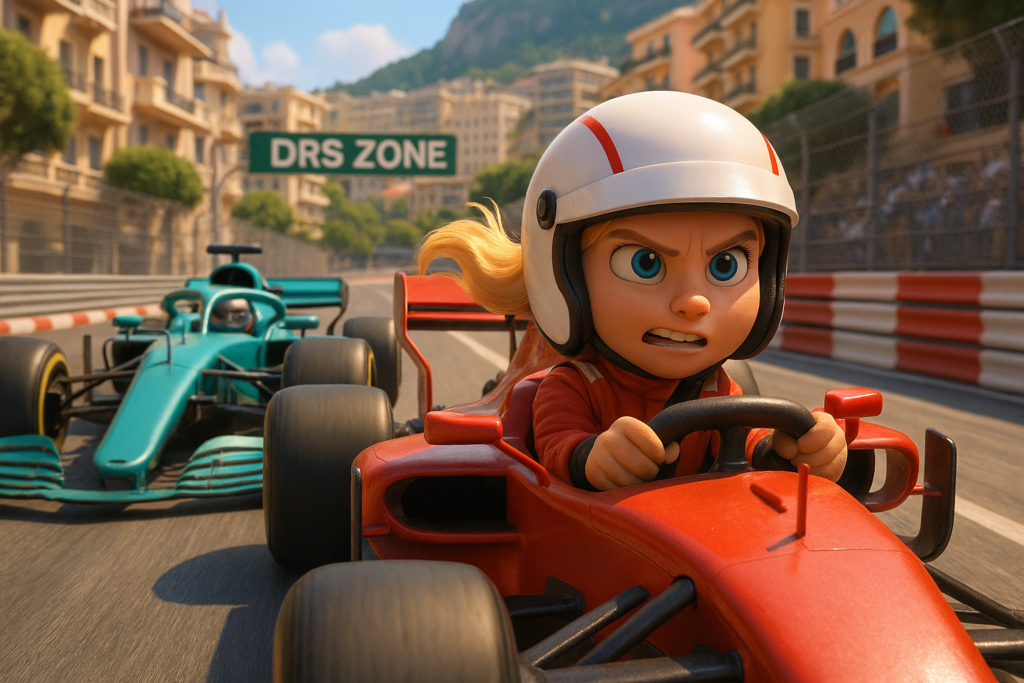
DRS still works better as the metaphor because the idea is simple: You reduce drag at the moment speed creates an advantage.
And that is exactly how I think about AI. Not as autopilot. Not as the driver. Not as a replacement for judgment. As a system that rewards the people who know where the drag is.
The next day, I met another engineer.
He had been sitting on a product idea for years. He had worked with dozens of startups, had deep technical experience, and knew the problem space well. But like many people, he never quite had the time to turn the idea into something real.
He told me he was skeptical when the AI hype started. Then, around the end of last year, he decided he had to engage with it properly. Not because he believed all the hype, but because ignoring it felt like a bigger risk.
By May 2026, he had a working prototype. A functional product, end to end, for three different user types.
AI did not build it for him. He built the foundation, the backend, the logic. All the parts that make non-engineers want to close the laptop and go stare at the sea, but AI helped him move through the friction faster.
Bugs did not stop him for as long. Blank canvas moments did not slow him down as much. UI elements became easier to assemble once the engine existed. That is not vibe coding. That is a skilled person using AI as leverage, and this is where I think the AI conversation often gets too flat.
We keep asking, “Which roles will AI replace?” But the more interesting question is: Which people will use AI to reduce drag? Because two people with similar skills can react completely differently.
For one person, AI feels like a countdown clock. For another, it feels like extra track opening up.
I see this in my own work too.
Before AI, I had never really used Google Apps Script. Now, five out of seven automated systems I use in my business rely on it in some way: automating sheets, calculating things, connecting APIs, cleaning up workflows.
I did not magically become a developer, but I did become someone who can build small internal systems I could not build before.
That distinction matters. AI can make me more capable, but it does not make me an engineer.
In the hands of a strong engineer, AI can accelerate product development. In my hands, it can help me build useful automations, prototypes, and workflows, but I still need to know where my limits are.
That, to me, is the real difference between using AI as a gimmick and using it as a performance system. AI is not my autopilot. It is my drag reduction system.
And I am still learning where the straights are.
