How to Get Your Expertise Cited by AI (AEO Strategy for Founders)
Your website ranks number one on Google. You did the work, the keyword research, the backlinks, the content. And yet, when one of your potential clients types a question into ChatGPT, your name doesn’t appear. Someone else does. A competitor with fewer credentials, a smaller site, maybe even less experience than you.
This isn’t a ranking glitch. It’s a visibility gap, and for founders who sell expertise, it might be the most important gap to close right now.
Here’s the uncomfortable truth: ranking on Google and being cited by AI are two completely different games. Research from Ahrefs found that only 12% of URLs cited by AI tools overlap with Google’s top 10 results. That means the vast majority of what AI recommends comes from sources that don’t even rank on page one. Your trophy position on Google won’t automatically translate to AI visibility.
But before you panic and abandon everything you’ve built, don’t. This article isn’t about throwing out your SEO playbook. It’s about understanding why the journey your potential clients take has changed, and what that means for how you build your presence online.
Let’s break it down.
What Is AEO and Why Should Founders Care?
Answer Engine Optimization (AEO) is the practice of structuring your content so that AI-powered tools (ChatGPT, Perplexity, Google’s AI Overviews, Microsoft Copilot) can extract, understand, and cite you as a trustworthy source.
Where traditional SEO optimised for search engine result pages (blue links), AEO optimises for something else entirely: the moment an AI decides whose knowledge is worth referencing in a response.
The distinction matters enormously for founders who sell knowledge, advice, or transformation. When someone searches for a marketing advisor, a SaaS consultant, or a business coach, they’re increasingly not clicking through ten websites to compare options. They’re asking an AI and getting a synthesised answer back. Sometimes with citations, sometimes without, but if your name and expertise don’t exist in that layer, you’re not even in the room when the decision begins.
Think of it this way: SEO captures demand. Public evidence creates it.
The Shift Isn’t SEO Dying, it’s the User Journey Changing
Here’s where most of the noise gets it wrong. Every few months, someone publishes an article declaring SEO is dead. It trends. People panic. Then SEO keeps working and the hot take disappears. We haven’t gotten there yet this time, but we have started to see evidence that AEO isn’t replacing SEO, it’s just changing the user journey entirely, and we all have our website analytics to prove it.
Gartner analyst Alan Antin put it plainly: “Generative AI solutions are becoming substitute answer engines, replacing user queries that previously may have been executed in traditional search engines.” Gartner predicted in early 2024 that traditional search engine volume would drop 25% by 2026. And by 2028, brands that don’t adapt could see up to a 50% decline in organic traffic.
That doesn’t mean Google disappears.
Consider the data from The Growth Memo: the average query length in traditional Google search is 3.37 words. The average prompt length in ChatGPT is 23 words, and some prompts reach over 2,700 words. People aren’t asking AI the same shallow questions they ask Google. They’re having a conversation. They’re explaining their context, their problem, their situation and expecting a thoughtful response back.
This is the shift. Not from Google to ChatGPT. From browsing to asking. From keyword queries to contextual conversations.
For founders, that distinction changes everything. Because when someone asks an AI a 23-word question about their business problem, the AI isn’t returning ten blue links. It’s synthesising a response from sources it trusts and either your expertise is woven into that response, or someone else’s is.
Why Your Ranking Doesn’t Guarantee AI Visibility
This is the part that surprises most founders when they first hear it.
A 2025 Pew Research study found that when an AI summary is present, users click traditional results only 8% of the time, compared to 15% when no AI summary appears. The attention that once flowed to your ranked page is being partially intercepted before it reaches you.
More striking is what AI actually cites. Research from Profound, which analysed 680 million citations across ChatGPT, Google AI Overviews, and Perplexity from August 2024 to June 2025, found that each AI platform has completely different citation preferences:
ChatGPT strongly favours encyclopedic, well-sourced content. Wikipedia accounts for 7.8% of all ChatGPT citations.
Google AI Overviews lean toward Reddit, YouTube, and diversified cross-platform sources.
Perplexity rewards specialisation, favoring niche directories and industry-specific platforms depending on your vertical.
And here’s the kicker: Profound also found that only 11% of domains are cited by both ChatGPT and Perplexity. These platforms don’t agree on who the authorities are. A strategy built around one platform’s preferences leaves you nearly invisible on the others.
Separately, a Yext analysis of 6.8 million citations across 1.6 million AI responses found that Gemini (Google’s AI) pulls 52.15% of its citations from brand-owned websites, meaning your own site actually matters here. But ChatGPT rewards broad distribution and consistency across platforms. And Perplexity rewards being accurately listed in trusted niche directories within your field.
One more finding worth noting, from Profound’s March 2026 data: LinkedIn is the most-cited domain for professional queries across AI Overviews, AI Mode, ChatGPT, Microsoft Copilot, and Perplexity. If you’re a B2B founder and your LinkedIn presence is thin, outdated, or disconnected from your core expertise, that’s a visible gap across every major AI platform simultaneously.
The pattern across all of this research points to one core principle: AI rewards breadth of presence, depth of expertise, and consistency of information – not just a single well-optimised web page. It rewards signals.
The Real Reason You’re Invisible to AI (It’s Not Technical)
Before we get into tactics, let’s name the real problem because most founders misdiagnose it.
The issue isn’t that you haven’t added the right schema markup. It’s not that your page speed is slow. Those things matter, but they’re not why your expertise is missing from AI conversations. The deeper reason is this: AI can only cite what it can find, understand, and trust. And for most founders, the public evidence of their expertise is thin.
Think about what an AI needs to confidently recommend you. It needs to see your name associated with your area of expertise — not just on your own website, but across multiple credible sources. It needs to understand what you know, not just what you sell. It needs to find your ideas referenced, quoted, or discussed in places beyond your own blog.
For many expert founders, the honest audit looks like this: a website that describes services, maybe a few blog posts, a LinkedIn profile that hasn’t been updated in a year, and no meaningful presence anywhere else. From an AI’s perspective, that’s not enough signal to confidently cite you as an authority. You might be brilliant. But brilliance with no public evidence is invisible.
This is why the approach that actually works isn’t a hack or a workaround. It’s the deliberate, systematic building of public evidence for your expertise across the right channels, in the right formats, at the right frequency.
What AEO Actually Looks Like in Practice
AEO isn’t a replacement for SEO. It’s an extension of the same foundation, taken into new territory. Here’s what it involves for a founder:
1. Be Findable Where AI Looks
Different AI tools pull from different sources. To be cited broadly, you need to be present broadly. Based on the research, for B2B and expert-led businesses, the priority platforms are:
- Your own website (structured clearly, with direct answers to real questions)
- LinkedIn (the most-cited professional platform across major AI tools as of March 2026)
- Reddit and community forums (heavily cited by Perplexity and Google AI Overviews – genuine participation, IF this is a relevant channel for you, not spam)
- Third-party publications (guest articles, expert quotes, interviews on industry sites – get those signals out there, if you need PR help, that is a complimentary solution to consider)
- Wikipedia and Wikidata (if your entity is notable enough – being listed increases citation likelihood by 2.8x according to data cited in the Digital Bloom’s 2025 AI Visibility Report)
The principle: your expertise needs to exist in many places, consistently saying the same thing, so that AI tools find corroborating evidence when they look you up.
2. Write for Extraction, Not Just Ranking
Traditional SEO writing optimises for a human reader skimming a page. AEO writing adds a second audience: the AI pulling a chunk of your content to use in a response. What does that mean practically?
- Lead with the answer. Start every major section with a clear, direct response to the implied question. Don’t build up to your point — open with it. Aim for concise answer blocks of 40–60 words before expanding.
- Use natural conversational language. AI is trained on how people actually talk and write. Dense, keyword-stuffed prose doesn’t extract cleanly.
- Answer related questions within the same piece. AI models think in intent and relationships. If you answer one question but ignore the follow-ups a reader would naturally ask next, you lose citation potential.
- Structure with headers and hierarchy. Clear H2s and H3s help AI understand the architecture of your thinking and extract specific sections cleanly.
3. Build Entity Authority, Not Just Page Authority
In traditional SEO, domain authority and backlinks are the primary trust signals. In AEO, what matters more is entity authority, how clearly and consistently the internet associates you with your area of expertise.
Research from iQuanti, shared at the DMFS Summit West 2025, found that entity authority beats backlink volume in AI answers. This is a meaningful shift. You can build entity authority through:
- Consistent authorship on published content (your name, bio, and credentials clearly attached to your work)
- Being quoted in media, podcasts, and third-party articles
- Structured data on your own site that clearly identifies who you are, what you do, and who you serve
- Keeping your information consistent across all platforms: the same name, the same title, the same area of focus
Fragmented identity confuses AI. Clear, consistent, corroborated identity builds it.
4. Earn Citations, Don’t Just Claim Authority
One of the most counterintuitive findings from the research is this: AI doesn’t just trust what you say about yourself. It trusts what others say about you.
Think about what gets cited most: Wikipedia (a collaborative, referenced source), Reddit (real people’s experiences and opinions), industry review platforms, press mentions, and expert quotes. These are all third-party validations.
For founders, this translates to:
- Being a source for journalists and bloggers in your niche
- Participating authentically in communities where your ideal clients spend time
- Seeking speaking opportunities, podcast appearances, and interviews that produce citable content
- Encouraging clients to leave reviews on platforms AI tools trust (G2 is the most cited software review platform on ChatGPT, Perplexity, and Google AI Overviews, according to a study by Radix)
The underlying logic here connects directly to Google’s E-E-A-T framework (Experience, Expertise, Authoritativeness, Trustworthiness) which has always mattered for search quality, and now matters even more for AI citation decisions.
5. Track AI Visibility Separately from SEO Rankings
This is where most founders are flying blind and it’s a real problem. You cannot manage what you cannot see.
Traditional SEO metrics (rankings, organic traffic, click-through rate) don’t tell you whether you’re being cited by AI or not. AI tools often don’t pass referral data in the same way a traditional click does. As the Contently report on AEO agencies noted, attribution is one of the biggest hurdles in this space: practitioners are triangulating log files, answer snapshots, and branded search lift to estimate impact.
At a minimum, founders should:
- Manually test their key questions in ChatGPT, Perplexity, and Google AI Overviews regularly
- Track branded search volume over time (a rise in branded searches often follows growing AI visibility)
- Monitor direct traffic as a lagging indicator, people who encounter your brand in an AI response often type your URL directly later
- Tools like Profound, Semrush’s AI features, and emerging AEO dashboards are beginning to make this more trackable, though the space is evolving fast
The Honest Caveat (Because You Deserve One)
AEO is a real shift that’s happening now. The research is clear on that. But it would be dishonest not to acknowledge that this landscape is also moving fast and somewhat unpredictably.
A Semrush study found that ChatGPT cited Reddit in close to 60% of prompt responses in early August 2025 and by mid-September 2025, that number had collapsed to roughly 10%. As reported by ALM Corp’s analysis of 2026 citation data, the most likely explanation is an intentional behavioural adjustment by the model itself. The rules of who gets cited can shift without warning.
This is exactly why AEO strategy must be built on foundations that don’t depend on gaming any single platform’s preferences. Real expertise, genuine public evidence, consistent presence across multiple channels, and content that actually serves the person asking. These don’t go out of date when a model updates.
The founders who will win in AI search over the next three years aren’t the ones who find the cleverest short-term hack. They’re the ones who build the kind of public authority that AI tools have no choice but to reference.
Where to Start: Your AEO Assessment
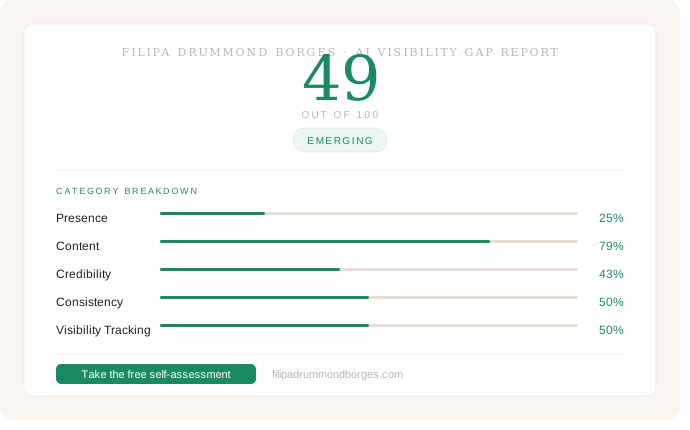
If you’ve read this far and you’re wondering where to actually begin, start with an honest audit of where you stand today. Here are the questions to ask:
Presence Audit:
- Does your name appear in ChatGPT, Perplexity, or Google AI Overviews when someone asks a relevant question in your niche?
- Is your LinkedIn profile complete, current, and clearly associated with your area of expertise?
- Are you mentioned or quoted anywhere outside your own website?
Content Audit:
- Does your content open with direct answers, or does it build up slowly to the point?
- Does each major piece of content answer multiple related questions, or just one?
- Is there a clear author identity attached to your published content?
Entity Audit:
- Is your name, title, and area of expertise consistent across all platforms?
- Are there structured data elements on your site that help AI understand who you are?
- Are you listed on relevant platforms and directories in your niche?
If you find gaps, and most founders do, the full audit at the end gives you a concrete starting point for closing them.
Frequently Asked Questions
Do I need to choose between SEO and AEO?
No. They work together — and you should treat them that way. Google’s AI Overviews have the strongest correlation with traditional search rankings of any AI platform. Your SEO foundation still matters. AEO extends that foundation into new territory; it doesn’t replace it.
How long does it take to show up in AI answers?
Technical fixes like schema markup can surface in AI tools within days. Building entity authority — through PR, citations, community presence, and third-party mentions — typically takes one to three months before you see consistent results. There’s no shortcut, but there is a clear path.
Can I track whether AI is driving me leads?
Not perfectly, yet. The clearest signals are: a rise in branded search volume, an increase in direct traffic, and clients who tell you they found you via ChatGPT or a similar tool. Tracking is improving with tools like Profound and Semrush’s AEO features, but the measurement ecosystem is still catching up to the behaviour shift.
Does my content need to be on my own site to be cited?
Not exclusively. LinkedIn, Reddit, third-party publications, and community forums are all regularly cited by major AI tools. Your site matters — especially for Google’s Gemini — but a multi-platform presence is more important than any single channel.
What if I’m just getting started online?
That’s actually an opportunity. Founders who build their digital presence with AEO in mind from the start don’t have to undo years of keyword-first content. Start with clear, structured, expertise-forward content. Be consistent. Distribute widely. Build evidence over time.
The Bottom Line
Ranking number one on Google is still worth something. It may always be worth something. But the question you need to add to your visibility strategy is this: “When someone asks an AI about my area of expertise, does my name come up?”
If the answer is no, or you genuinely don’t know, that’s the gap to close.
The user journey has changed. People are no longer just searching; they’re asking. They don’t start searching until they already have clear names to research, which is when they seem to switch either to google or to directly to your website. Which means that even your organic traffic, could come originally from AI, or their journey could have started within an AI conversation.
The founders who will have the most visible, trusted, citeable expertise in the AI era won’t be the ones who gamed an algorithm. They’ll be the ones who put their genuine knowledge in front of the right people, in the right formats, across the right channels – consistently enough that AI had no choice but to notice.
That’s what AEO is really about. Not cheating a system. Building evidence of expertise that earns its place.
Where do you actually stand?
Most founders reading this will recognise the gap — but won’t know how severe it is, or where to start. This self-assessment takes 12–15 minutes and gives you a scored gap report across the five dimensions that determine whether AI cites your expertise.