entry 005 ·19 October 2026 · covering 12–19 October
This week, the most interesting developments weren’t about making AI more capable. They were about making automated decisions more accessible, more measurable, and, importantly, more accountable.
(I can barely breathe. Governance. Audit trails. Truly the glamorous end of the industry.)
Shopify opened its shopping infrastructure to independently configured AI agents. Google changed how websites appear inside AI Search and introduced new advertising measurement tools. Meanwhile, a new model from Google, new agent-governance infrastructure, and an unusually practical CRO publication all point toward the same underlying issue.
The technology is moving faster than our ability to evaluate what it’s actually improving.
We all saw that coming, but it still matters because a system can generate more conversions in an advertising dashboard without generating more sales. An AI agent can successfully complete a purchase while introducing new consent and attribution questions. And a more capable reasoning model can produce a convincing analysis that still uses the wrong business definitions.
For my work, I think this week’s strongest opportunities sit at the intersection of measurement integrity, AI-mediated commerce, and evidence-based workflow design.
1. Shopify has opened its shopping infrastructure to almost any AI agent
13 and 16 October · Agentic commerce / CRO / Analytics
On 13 October, Shopify introduced Shop MCP, allowing developers to connect compatible AI agents directly to Shopify’s commerce infrastructure.
Through a single connection, an agent can search a catalogue containing more than one billion products, retrieve product details, build carts, initiate checkout, and retrieve orders.
Search doesn’t require an API key. Customers can sign in with Shop and use their saved addresses and Shop Pay details. Purchases require the shopper to confirm the total and payment method.
This is a meaningful expansion beyond Shopify’s existing integrations with individual AI platforms.
Three days later, Shopify added support for buyer consent within agentic cart and checkout flows. Agents using the relevant Universal Commerce Protocol extension can now present store-specific privacy and marketing choices, including email and SMS consent.
Why it matters
We’ve discussed agentic commerce repeatedly, but this week’s change is operationally different.
Previously, much of the conversation revolved around whether individual AI platforms would integrate with individual retailers. Shopify is making the underlying commerce functions accessible to a broader ecosystem of agents.
That changes the integration problem.
Instead of building a separate shopping experience for every AI assistant, developers can potentially connect to a common set of commerce capabilities.
But here’s the thing, the checkout is becoming a service that can be invoked by different interfaces. The customer may interact with an AI assistant, while the actual commerce infrastructure belongs to Shopify and the merchant.
That introduces a new layer between customer intention and transaction execution.
Client angle
For ecommerce clients, do we need to start distinguishing between three experiences:
- Human-facing experience: How well does the website help customers understand, compare and purchase?
- Machine-facing experience: Can an agent accurately retrieve product information, pricing, availability and policies?
- Transaction experience: Can the customer complete a purchase safely, with appropriate confirmation and consent?
All three affect conversion, but they require different forms of evaluation.
There is also a measurement detail worth noting: Shopify says Shop MCP doesn’t provide checkout webhooks at launch, so integrations need to check checkout status through the API.
That makes transaction reconciliation particularly important.
Practical opportunity
Eventually I’ll have to add an Agentic Checkout QA component to ecommerce audits.
It would verify product accuracy, checkout completion, consent handling, order creation and attribution. And I’d include one test that sounds obvious but may become increasingly important:
Does the customer understand exactly what they’re authorizing the agent to purchase?
Reducing interaction steps is only an improvement when it preserves informed consent.
2. Google is changing how links appear inside AI Search
15 October · SEO / AEO / Search visibility
On 15 October, Google announced several changes to AI Mode and AI Overviews.
These include more prominent inline links positioned higher in AI-generated responses, a test highlighting official websites for queries where users need a specific destination, expanded news carousels across additional countries and languages, and more visual links to related content.
Google is also testing clickable creator and publisher profiles within video results.
The official-website feature is a test, while other changes are rolling out more broadly. Google hasn’t published evidence establishing how much additional website traffic these changes will produce.
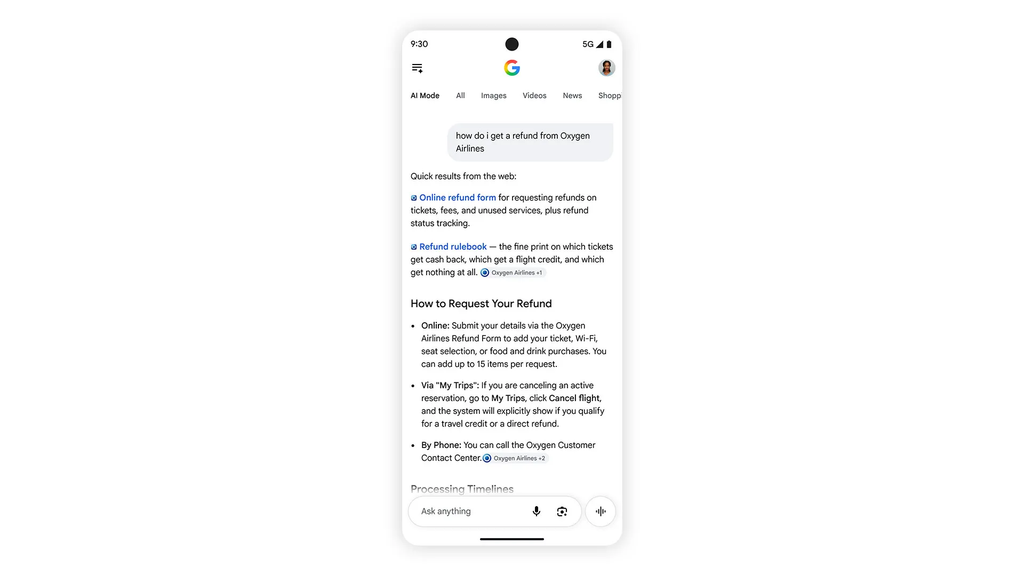
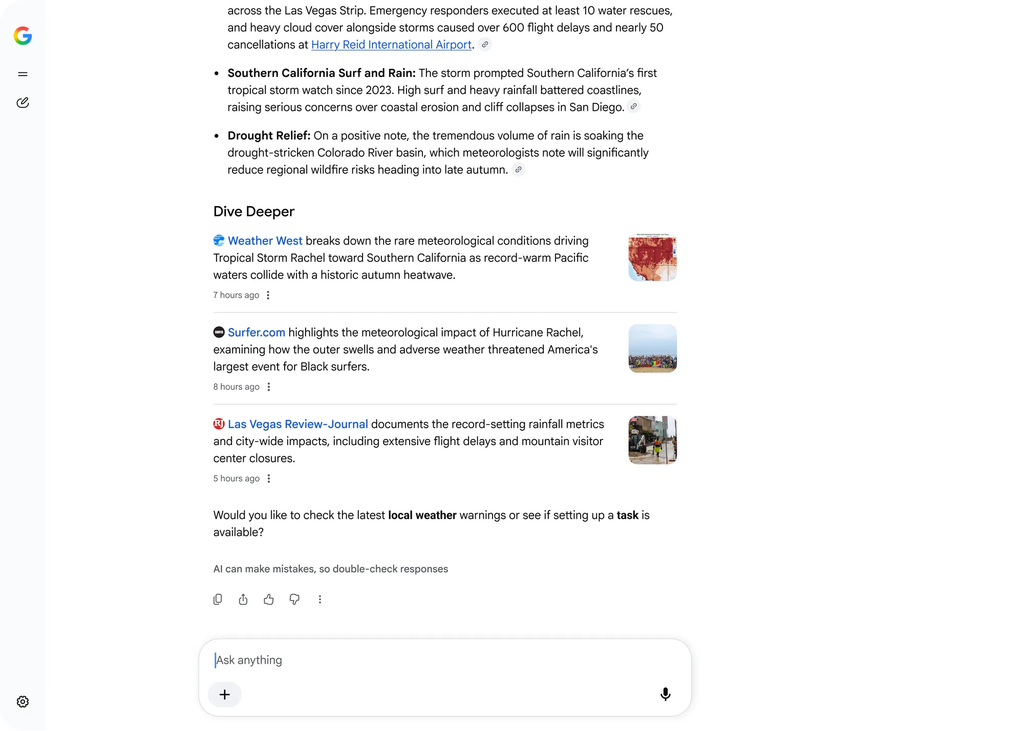
This complicates the increasingly popular argument that AI Search inevitably means fewer clicks. Google is experimenting with ways to make external links more prominent within the AI experience itself.
That doesn’t establish that AI Search will send more traffic overall, but it suggests the relationship between answer generation and website navigation is still being actively redesigned.
I find the official-website test particularly relevant to commercial search.
Sometimes an AI can explain something perfectly well, but the user still needs to visit an authoritative destination to complete the task.
Think about booking a trip, checking actual availability, accessing an account or making a payment.
The website remains necessary for the transaction, even when the informational journey happens elsewhere.
Client angle
It may be too soon but, for travel and ecommerce, we may have to consider separating AI Search visibility into two broad intent groups.
- Informational intent: Queries where an AI answer might satisfy the user without a click.
- Task-completion intent: Queries where the user still needs to reach a website, application or transaction environment.
The second group may become particularly valuable.
For a travel agency in Romania, for example, there’s a meaningful difference between appearing in an answer about the best time to visit Thailand and appearing when someone needs to check available packages departing Bucharest.
Both represent visibility. Only one necessarily implies an immediate commercial action.
The question isn’t just whether AI mentions the business. It’s whether AI helps the customer reach the business when reaching it matters.
3. Google Ads introduced a metric that could make measurement improvements look like business growth
13 October · PPC / Analytics / Attribution
This is probably the week’s most immediately actionable advertising development.
What changed
Google announced a new Data Strength Uplift metric for Google Ads.
The metric is intended to help advertisers understand conversion gains associated with improvements to their first-party data and measurement setup.
Google also announced that Data Manager is expanding to Google Analytics and Display & Video 360, with enhanced conversions planned for those environments.
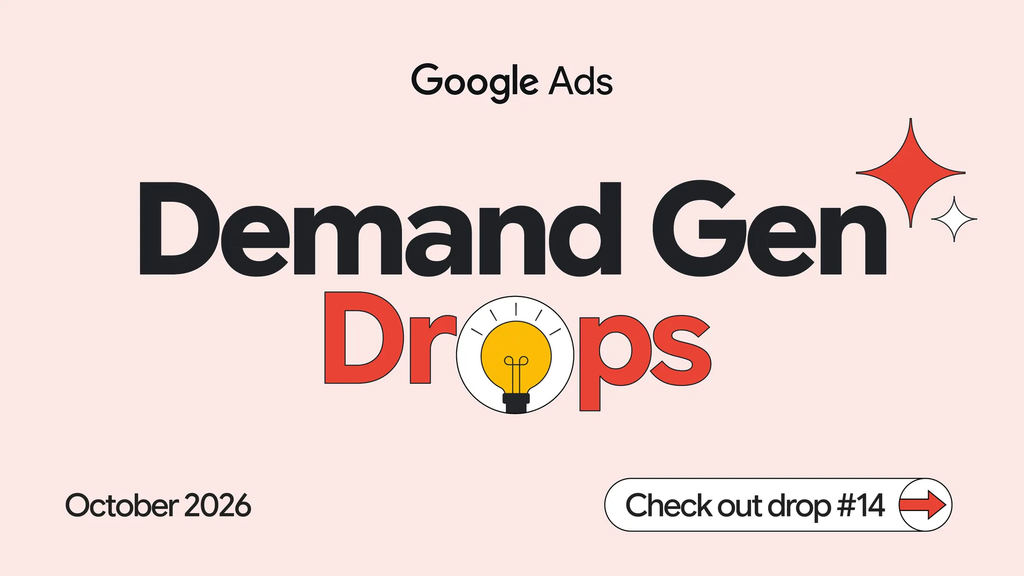
According to Google’s internal analysis of Demand Gen campaigns between 3 and 17 June 2026, advertisers using Google Tag Gateway to strengthen their measurement saw, on average, more than 20% conversion uplift.
That figure comes from Google’s own analysis, and the announcement does not provide enough methodological detail to interpret it as a general causal estimate of additional sales.
Practical opportunity
This could become a useful component of an Analytics Integrity Audit.
The deliverable would distinguish improvements in observed conversion volume from improvements in actual business performance.
For advertisers adopting Data Strength Uplift, I’d establish a before-and-after reconciliation against independent order data.
It’s a small methodological improvement with potentially large consequences for budget decisions.
4. Gemini 4 Argon is a model launch worth testing for real analytical work
13 October · Models / AI workflow systems
What changed
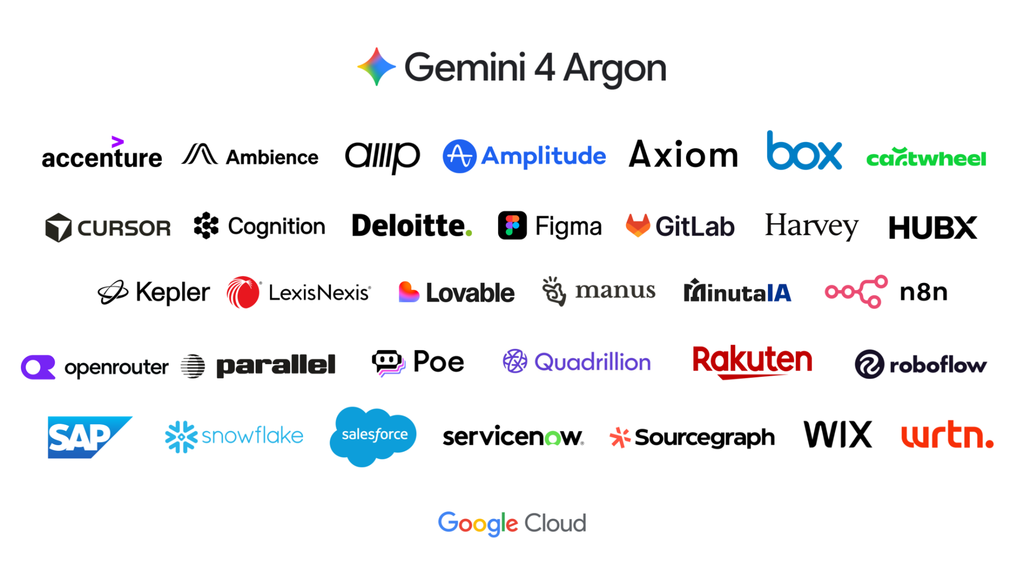
Google released Gemini 4 Argon, its new frontier model designed for complex, multi-step work.
The model is available through Google’s enterprise and developer environments, including the Gemini API and Google AI Studio.
Google emphasizes long-running tasks, structured reasoning, software development, quantitative analysis and working across large collections of documents.
The introductory API pricing is $2 per million input tokens and $10 per million output tokens through 30 November. Google says standard pricing will then increase to $4 and $20 respectively.
Google also reports improvements in code development, quantitative reasoning and resistance to prompt injection.
These are useful indicators, but vendor benchmarks and selected early-adopter results should not be treated as proof that the model will outperform alternatives on a particular marketing workflow.
Why it matters
Google is explicitly positioning Argon for long-horizon work that requires maintaining context, executing multiple steps and producing verifiable outputs.
That’s directly relevant to analytics workflows. Consider a CRO investigation requiring the system to:
- Retrieve GA4 data.
- Compare performance periods.
- Check instrumentation.
- Reconcile CRM outcomes.
- Review qualitative evidence.
- Separate confirmed findings from hypotheses.
- Produce recommendations.
It’s a much more demanding task than summarizing a document. A model needs to maintain the analytical objective while moving between different sources and methods.
5. ServiceNow is turning AI permissions into something machines can verify
15 October · Agent infrastructure / Governance
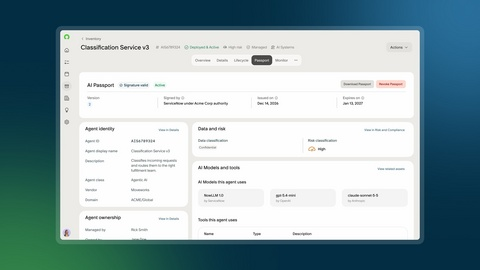
ServiceNow announced AI Passport, a new authorization system for AI agents and Model Context Protocol servers.
The idea is to give agents cryptographically verifiable credentials defining what they’re permitted to do.
Those permissions can be checked during execution, rather than relying solely on instructions inside a prompt.
ServiceNow also announced expanded capabilities for discovering unauthorized agents, monitoring behavior, managing costs and comparing AI expenditure with business outcomes.
AI Passport and several associated capabilities are expected to become available during Q4 2026.
Why it matters
We have all discussed the difference between an AI agent being capable of performing an action and being authorized to perform it. This week’s announcement introduces a concrete infrastructure approach to that problem.
A prompt might say:
Don’t modify advertising budgets without approval.
But that instruction is not equivalent to preventing the agent from accessing the budget-editing function. An authorization system can enforce the boundary outside the model’s reasoning process. That’s a fundamentally different form of control.
Client angle
For marketing automation, this matters when agents have access to advertising platforms, CRMs, analytics properties and content-management systems.
We would need to separate permissions into:
- Observe: Read data and identify issues.
- Recommend: Propose actions.
- Prepare: Create drafts or changes awaiting review.
- Execute: Perform explicitly authorized actions.
The permissions should reflect the actual business consequences of each action.
Practical takeaway
Permissions should be technically enforced wherever possible, not merely described in natural language.
For my own analytics agent, that means read-only access by default, explicit approval for modifications and an auditable record of consequential actions.
6. Meta is letting users describe what they want from its recommendation algorithm
13 October · Digital customer behavior / Paid media
What changed
Meta announced Your Algorithm, a new Facebook feature that allows users to describe their interests in natural language.
Users can indicate which topics they want to see more or less frequently in Feed and Reels.
Meta says its recommendation systems can interpret this feedback and adjust recommendations during the same session.
The update also introduces more conversational feedback options when users mark content as interesting or uninteresting.
Why it matters
This is an interesting behavioral change. Traditional recommendation systems infer preferences from actions.
What did someone watch? What did they click? What did they ignore?
Meta is introducing a more explicit layer where users can communicate preferences directly. Observed behavior and stated preference are not always the same thing. Someone might watch several videos about a topic without wanting their feed to become dominated by it.
Equally, someone may express an interest before they’ve demonstrated it through engagement.
Practical opportunity
The broader idea is worth carrying into CRO. We’ve become very good at inferring intent from behavioral data, but sometimes the most useful thing is to just ask.
Could we make it easier for customers to tell us what they’re trying to accomplish?
For complex ecommerce or travel journeys, explicit preference capture may reduce unnecessary exploration.
That is a hypothesis worth testing rather than an established outcome of Meta’s announcement.
7. Baymard published a useful reminder that finding UX problems isn’t the same as fixing them
15 October · CRO / UX research
Now, this isn’t a new behavioral discovery, but it’s a practical addition to the week’s research.
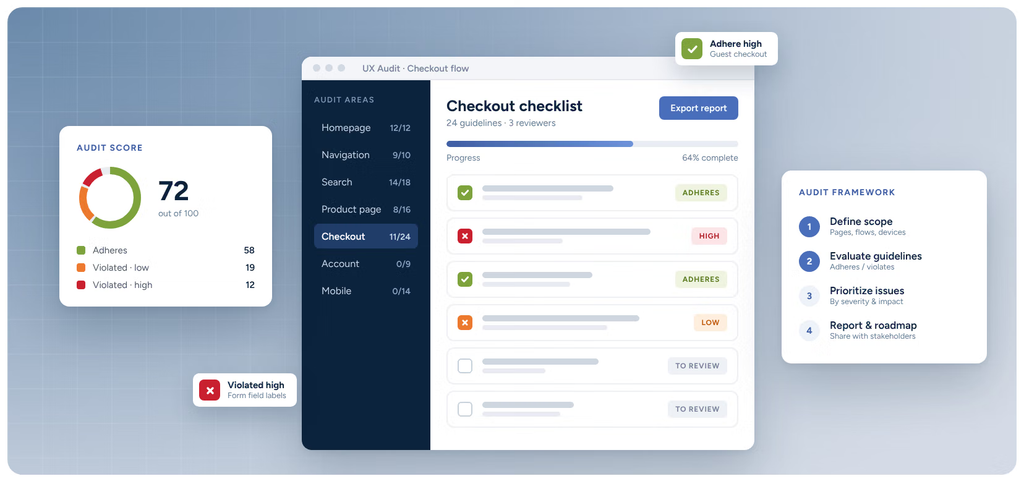
Baymard Institute published a new UX audit framework focused on moving from observations to prioritized, reproducible recommendations.
The framework emphasizes documenting issues clearly, evaluating severity and frequency, estimating commercial impact and defining success criteria before implementing changes.
It draws on Baymard’s existing ecommerce usability research rather than presenting a new controlled experiment.
Why it matters
This could be interesting for the way CRO work gets managed inside organizations. Identifying friction is only one part of the job.
A finding needs to survive several additional questions.
- Can someone reproduce it?
- How many users encounter it?
- How seriously does it interfere with their task?
- What is the likely commercial consequence?
- What would constitute a successful fix?
Baymard recommends prioritizing issues according to severity and frequency, then considering implementation effort.
My main takeaway this week, is less of a conclusion and more of a wonder.
Where are we in the AI hype cycle? Especially for us marketeers, which phase and what signals can we starting to see?
Adoption is pretty much here. Conductor surveyed of 250+ CMOs, 97% said AEO is already having a positive impact, and 94% plan to spend more on it. Self-reported though, so let’s take it with a punch of salt, nobody likes telling a survey their bet isn’t paying off. Meanwhile, the Stanford AI Index 2026 says that generative AI reached 53% population adoption in just three years.
Three years. Most of us are still fixing our footer links.
The audience for AI-generated answers is already huge, and it isn’t waiting for anyone to feel ready.
- Add shopping and Shop Pay checkout to any agent with Shop MCP, Shop MCP announcement, 13 October by Shopify
- Checkout MCP and Cart MCP now support UCP buyer consent, Buyer consent update, 16 October by Shopify
- More ways to connect with the web from Search, Google’s official Search announcement, 15 October by Google
- Build your data strength with October’s Demand Gen drop, Google’s October Demand Gen update by Google
- Gemini 4 Argon available on Google Cloud, built to help solve your business’ hardest problems, Google Cloud’s Gemini 4 Argon announcement
- Gemini 4 Argon is now available for developers, Google’s developer availability details
- ServiceNow advances its operational harness for enterprise AI with AI Passport and expanded governance capabilities, ServiceNow’s official announcement, 15 October
- Source:
- Your Algorithm, Your Words: New Ways to Shape What You See on Facebook, Meta’s official announcement, 13 October
- UX Audit Checklist & Template Framework for Designers, Baymard’s UX Audit Checklist and Framework.