Last time I wrote about ChatGPT building a Search Console. That was about the front of the journey: whether your business shows up in answers.
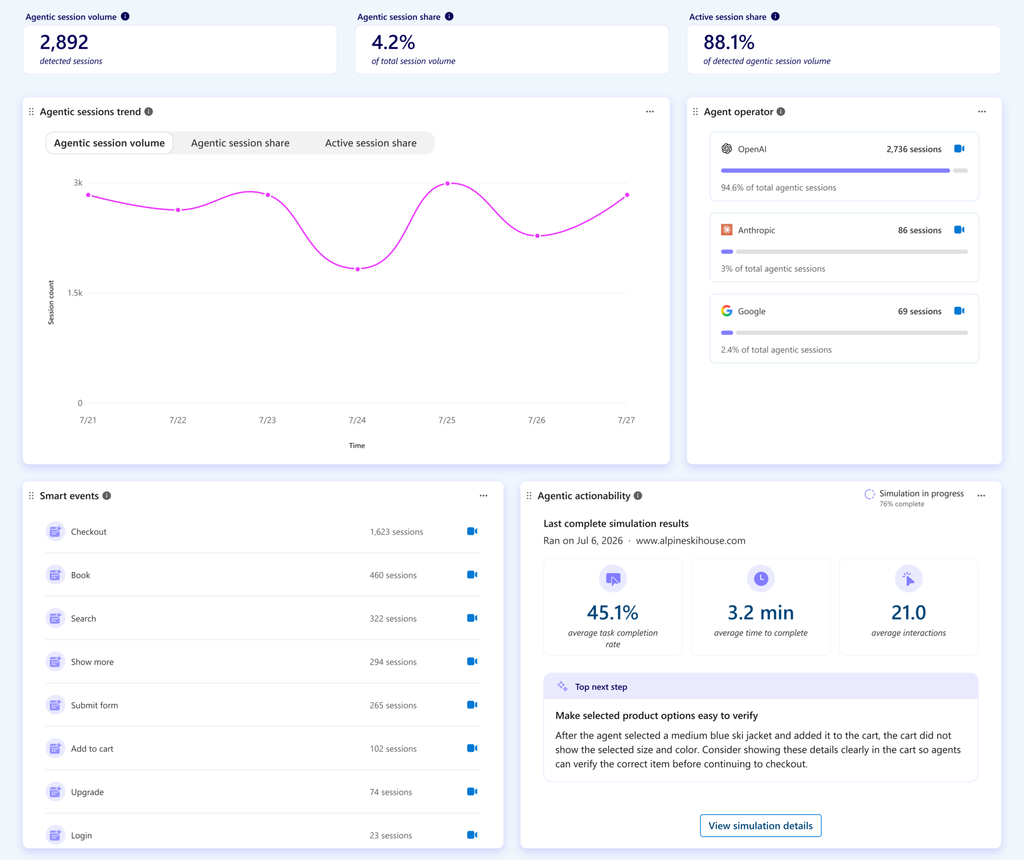
This time, five days ago to be exact, Microsoft announced the other end. Clarity, its free analytics tool, now claims to show what AI agents do once they land on your site.
Microsoft’s framing is that agents act, LLMs recommend, and people browse. Three journeys, one site. I like it, and I’m slightly allergic to how tidy it sounds. So here’s my read.
What launched

Three things, announced on 4 November:
- Agent Activity dashboard. It shows how agentic traffic changes over time, which agents visit, and what they do: searches, form submissions, logins, downloads, bookings, checkouts.
- Simulations. You test whether an agent can complete a key task on your site, and see whether it finished, how long it took, and how many interactions it needed. It starts with commerce and travel.
- Ask Clarity. You ask a question in plain language and get an answer backed by session recordings. It’s in closed beta for retailers, with AI Visibility and ad data listed as coming later.
There’s also Brand Agents, which puts products into Copilot and Bing for eligible WooCommerce and Shopify merchants. That’s distribution rather than measurement, so I’m leaving it aside here.
Microsoft says weekly sessions from AI agents almost doubled in three weeks, to nearly 2 million. That comes from their own study of 5.2 million agentic sessions across about 230,000 Clarity projects, between mid-August and early September.
The detail I found more interesting: checkout made up about 25% of agentic sessions’ recorded actions, against about 15% for human sessions. Humans clicked outbound links far more. So agents aren’t doing different things so much as weighting them differently. They head for the transaction.
I am not sure how to interpret this yet. Trust is a big part of the user journey, so we have to consider traditional brand trust, but also how much the human directing the agent trusts it to find the best deal and complete the purchase.
We may start seeing these changes in the journey for lower risk purchases such as grocery baskets before we see them in a travel booking, for example.
Who gets the most from it
Analysts can see whether agent traffic is growing and which journeys it attempts. UX teams get session evidence on where agents struggle. Developers get a repeatable test instead of a hunch. SEO and GEO people get a measurement layer between “an LLM recommended me” and “something actually got done.”
That last one is a point we keep coming back to. Being recommended and being completable are two different problems, and until now we’ve mostly measured the first.
I’d add one caution. The idea that agents stumble at the same friction points as people, only sooner, is plausible. It’s also a hypothesis, not something Microsoft claims. It’s exactly what I’d want to test rather than assume.
I plan to use this in my CRO work to understand the differences in the user journey. The goal and the intent should stay the same, because a real human is still telling the agent what they need. But when I start building a new website, how much of it will be for humans to engage with, and how much for agents?
The fine print, the interesting part
Microsoft is upfront about the limits, and I’d keep these in mind before building a strategy on the headline:
- An “agentic session” can include a human taking over partway. Clarity can’t yet separate the two, so the data shows activity in sessions involving agents, not proof an agent finished a task alone. This makes it harder to answer my question about the human and agent split.
- The events are counted independently. They aren’t steps in a funnel and they don’t verify completion.
- Only agents from OpenAI, Google and Anthropic are currently detected, and simulations cover only commerce and travel.
- The “88% discovered something new” stat for Ask Clarity comes from a survey of 16 early-access users. That’s 14 people. That’s too small a sample to read much into, but it’s an interesting direction.
So, I have two situations in front of me.
For one travel ecommerce client, I already use Clarity. The new features haven’t reached that account yet, but it’s only a matter of time. I’m curious what the new dashboard shows, and travel is one of the two verticals simulations start with, so there’s a fair chance it has something to say.
For a supermarket chain client, I’ve been running experiment audits built on research design: how the site is used by LLMs, how the journey is changing, and whether the site is ready for agent-assisted journeys. I won’t share findings here, but I can say how this lands.
The observation layer versus the design layer. An experiment tells you what happened to the thing you set out to test. A tool like Clarity tells you what happened that you didn’t set out to test. I think we need both. Without the design, the dashboard is a pile of sessions. Without the observation, the design mostly confirms what you already thought to ask.
On top of validating – or not – any given hypothesis, experiments often surface surprises that we didn’t think to test or ask. They force us to think about alternative solutions to the problem in front of us, but it’s not always the case, not all experiments inspire new ones. Monitoring and observing behavior tends to, it exposes us to behavior we didn’t expect or prepare for, sometimes we find issues, other times we trip on interesting opportunities.
Same rule as last week: hypothesis first. Before opening the dashboard, I want to have committed to a few predictions in writing.
- What share of my traffic do I expect to be agentic? (Then look.)
- Where do I expect an agent to get stuck? Probably checkout, a promotion, a date picker.
- Which pages do I expect agents to reach that I wouldn’t have guessed?
If I look first, I’ll rationalize whatever I see. If I commit first, I might learn something.
The travel website I work with, like many others, involves a lot of browsing. Users need to view multiple locations or hotels or offers before committing, it’s also a high end ticket for the most part so users take their time before hitting purchase. I wonder if agentic browsing will:
- Decrease the time users spend browsing and learning about the offers because they come into the website with a couple of options in mind
Or - If it will make the checkout funnel more efficient once users make that decision
Or - Both?
What I would actually do this week
- If you already run Clarity, check whether you have agentic traffic. It costs nothing to look, and an empty dashboard is also a finding.
- Write your predictions down before you open it.
- If you’re in commerce or travel, run a simulation on one key task and note where it breaks.
- Put it next to your own baseline. If you track what LLMs say about you, look for gaps between that and what agents actually do on the site.
- Don’t rebuild anything yet. Watch for a few weeks, because the first numbers will be noisy.
The dashboard will tell you what agents are doing. Why, and whether it matters for your business, is still your job.
Sources to link:
- Microsoft Clarity announcement
- What AI Agents Do on Websites: Insights From 5.2 Million Sessions
- Jonathan Saipe’s The LinkedIn post – thanks for the guidance on “Who gets the most from it”.