

How to Use AI as a Thinking Partner (Not Just a Tool)
According to McKinsey, 88% of business leaders say their organisations are deploying AI, and 86% of those same leaders admit they weren’t prepared to actually integrate it into day-to-day operations. Separately, a Deloitte 2026 report found that 37% of organisations are using AI only at a surface level, with little to no change to how they actually work.
🔗 Source: McKinsey & Company — The state of AI in 2024
That’s not an AI problem. That’s a thinking problem.
Most people use AI the way they used to use a search engine – type a question, get an answer, move on. And it works, up to a point. The problem is that this approach produces generic output. It’s fast, but it doesn’t make you better. You’re asking AI: “What would most people say about this?” And that’s exactly what you get: the average answer, packaged in a slightly different wrapper every time.
There’s a different way to work with AI that most people skip. Instead of asking for answers, you use it to improve how you think. This article walks you through that shift — and gives you a practical framework to apply it from your next session.
Why Most AI Use Falls Flat
The typical AI workflow looks like this: open a chat window, type a vague question, get a vague answer, feel mildly disappointed. Repeat.
The root cause isn’t the tool, it’s the approach.
When you give AI no context, no constraints, and no specific question, it defaults to producing what’s most probable given the words you used. It doesn’t know who you are, what you’re building, or what problem you’re actually trying to solve. So it gives you something that sounds plausible but doesn’t quite fit.
This plays out at scale too: the Freelancer Kompass 2026 report found that while 84% of freelancers now regularly use AI tools, only 39% feel strategically fluent with them. The gap isn’t adoption, it’s depth.
There are many experts who will teach you how to “build” a system to fix this. And some of those systems are genuinely useful. But before you invest in the tools, try to understand what type of context matters for you and your specific use case. I use different systems depending on the work – some are as simple as maintaining a NotebookLM, others require more technical setup – but they all solve the same core problem: I no longer need to worry about having a bad memory, decision paralysis, or a blank canvas every time I open a new session.
The failure of AI as a shortcut machine is ultimately this: the output is only as good as the input. And most inputs are lazy, not because people are lazy, but because no one told them a better way exists.
Research from MIT and Stanford on human-AI collaboration consistently shows that output quality correlates more strongly with how the task is framed than with which model is used.
🔗 Source: MIT Sloan Management Review: When humans and AI work best together — and when each is better alone
🔗 Other interesting sources on this topic, for those who are more curious:
What It Means to Use AI as a Thinking Partner
An AI thinking partner is a system that helps you clarify problems, explore options, and improve decisions, not just generate outputs.
The distinction matters. Using AI as a tool means you’re looking for answers. Using AI as a thinking partner means you’re using it to sharpen the question, pressure-test an assumption, or map a decision before you make it.
This isn’t a metaphor, it’s a practical shift in how you structure every prompt.
The difference looks like this:
- Tool mindset: “Write me a content strategy for my business.”
- Thinking partner mindset: “I run a service business with ten clients per year and no content presence. Given that my bottleneck is trust, not traffic, what type of content would actually move the needle? Help me think through the logic before I start writing.”
Same tool. Completely different outcome.
The C-Q-O Framework: A System for Better AI Thinking
The reason most AI prompts underperform is structure, or the lack of it. Here’s a three-part framework that fixes this reliably.
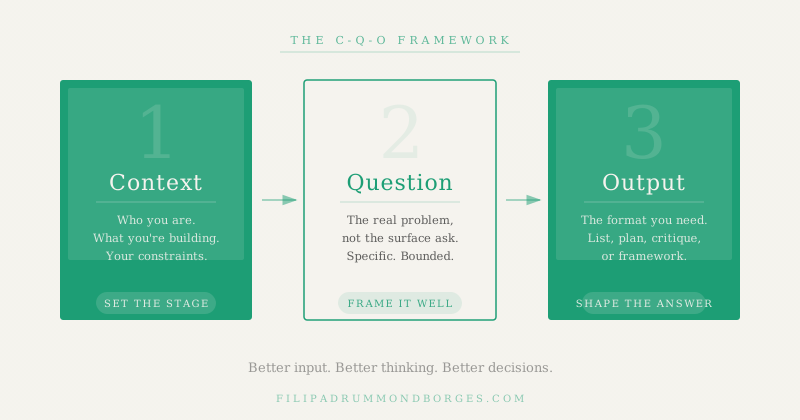
Context
Context is what AI needs to know before it can give you a useful response. Without it, every answer is a best guess aimed at nobody.
Good context includes:
- Who you are and what you do
- What you’re working on right now
- Who your audience or client is
- Constraints: time, budget, prior decisions already made
Example: “I’m a marketing strategist working with small service businesses in Portugal. My clients typically have low website traffic but high-value, relationship-driven sales cycles.”
That single paragraph changes everything that follows.
Question
The question is where most people lose the most value. Vague questions produce vague answers.
The goal is to ask something specific enough to be answerable, but open enough to generate real thinking, not just a list.
Compare:
- Weak: “How do I grow my business?”
- Strong: “Given this context, what are the highest-leverage changes I could make to increase conversions without increasing traffic?”
The second question has a direction, a constraint, and a clear problem to solve.
Output Format
Telling AI how to structure its response is often the fastest way to improve quality. Most people skip this entirely.
Instead of letting AI decide, specify what you need:
- “Give me three options with trade-offs for each.”
- “Build me a decision framework with clear criteria.”
- “Challenge my assumptions and tell me what I might be missing.”
- “Give me a prioritised list with estimated effort and impact.”
The format shapes the thinking. A step-by-step plan and a devil’s advocate critique are both useful, but only if you ask for what you actually need.
Three Practical Workflows You Can Start Using Today
These aren’t abstract prompting tips. Each one solves a specific real-world problem.
1. The Decision Framework Builder
Use this when you need to make a recurring decision and want a repeatable system, not just a one-time answer.
Prompt template: “Help me build a decision framework for choosing [X]. Include the criteria that matter most, the trade-offs between options, and the signals that would indicate one option over another.”
Works well for: selecting tools or platforms, pricing your services, evaluating client or project fit.
2. The Gap Analyzer
Use this when you have a strategy, a plan, or a piece of work and want to find what’s missing before someone else does.
Prompt template: “Based on this strategy [paste it], what are the biggest gaps, risks, or blind spots I haven’t addressed?”
This is particularly powerful for business planning, content strategy, and product decisions, any situation where overconfidence is a real risk.
3. The Assumption Challenger
Use this when you want to pressure-test your own thinking before you commit to a direction.
Prompt template: “Here’s my current thinking on [X]. What assumptions am I making that could be wrong? What would have to be true for this to fail?”
Most decisions go wrong not because of missing information, but because of unchallenged assumptions. This workflow surfaces them before they become expensive.
The Compounding Advantage: Context Over Time
Here’s something most AI users miss: context compounds.
The more consistently you bring detailed context into your prompts, the more useful AI becomes, not because the model changes, but because the signal improves. Over time, if you build reusable context blocks (a paragraph about your business, your audience, your constraints), you stop starting from zero with every session.
This is why the most effective AI users aren’t necessarily the most technically sophisticated. They’re the ones who’ve taken the time to articulate their own thinking clearly. The AI reflects that clarity back at them, refined and structured.
It’s not about prompting better. It’s about thinking better and letting AI make that visible.
Frequently Asked Questions
What is an AI thinking partner?
An AI thinking partner is a way of using AI not to get answers, but to improve the quality of your thinking. Instead of asking “what’s the answer?”, you use AI to clarify problems, explore options, challenge assumptions, and structure decisions before you make them.
How is using AI as a thinking partner different from regular AI prompting?
Regular prompting is transactional: you ask a question, you get an answer. Using AI as a thinking partner is collaborative: you bring context, define the real problem, and use AI to pressure-test your thinking rather than replace it. The output isn’t just faster; it’s more useful.
What is the C-Q-O Framework for AI?
The C-Q-O Framework is a three-part structure for writing better AI prompts: Context (who you are and what you’re working on), Question (a specific, well-framed problem to solve), and Output (the format you need the response in). Together, they turn a vague prompt into a focused thinking session.
Can anyone use AI as a thinking partner, or is it only for technical users?
Anyone can use it. The shift isn’t technical, it’s structural. Once you understand that AI responds to the quality of the input you give it, the improvements are immediate. No technical knowledge required.
What types of decisions is AI most useful for as a thinking partner?
AI works well as a thinking partner for decisions that involve multiple options, unclear trade-offs, or hidden assumptions, such as business strategy, pricing, content planning, and evaluating new ideas. It’s less useful for decisions that require lived experience, relationship context, or domain expertise that can’t be put into words.
Final Thought
Most people will use AI to move faster. A smaller group will use it to think better. Over time, that difference compounds — in the quality of decisions made, strategies built, and work produced.
The shift doesn’t require a new tool or a technical background. It requires a different question: not “what’s the answer?” but “how do I think about this?”
That’s the upgrade.
Up next: “Most Websites Don’t Have a Traffic Problem. They Have a Clarity Problem.” — the second piece in this series on strategic clarity.
